

Affordable Healthcare
Right now, 340,000 Minnesotans do not have health insurance, and 700,000 Minnesotans are worried about losing their health insurance. We have good cause to worry, because the average cost of health insurance has increased by 20% since 2025. To make things worse, health costs will increase dramatically again in 2027 as a result of Trump's "Big Billionaire Bill." (Source: MN Dept of Health, 2026)
Every single dollar of profit made by the insurance companies is made by denying people the care that they need. We don’t have to wonder why the United States continues to underperform other developed nations in key health metrics such as infant mortality and life expectancy. That's why I am advocating for a state-based, single-payer universal healthcare system here in Minnesota.
People always ask: where's the money going to come from to pay for this universal healthcare plan? The truth is, we already pay more than enough for health insurance, and under the new system, your costs would likely not increase. According to a Yale University study, a universal healthcare plan could actually save an estimated 20%.
Costs will be reduced by lowering administrative burden, reducing the cost of prescription drugs, and improving overall health outcomes. The universal healthcare system will increase coverage for all essential services, eliminate per-visit fees, and make costs more transparent. Most importantly, it will ensure that healthcare is focused on health, not making money. You can read about the Minnesota Health Plan in Senator John Marty’s book, Healing Health Care.
My opponent, Representative Max Rymer, has proposed the exact opposite plan: he wants to implement a pre-Obamacare approach where insurance companies are allowed to deny people care for pre-existing conditions. Under Rymer’s plan, people with health conditions could see their insurance costs increased by 25%. Additionally, the state would have to subsidize the high-risk insurance premiums by up to 200%. This means that taxpayers would pay for the high-risk pool anyway. In the end, it would not improve healthcare costs nor quality.
Last session, Representative Max Rymer voted against eliminating co-payments for minors for mental health services (HF32); and voted against a bipartisan bill extending access to discounted drugs in the federal 340B program (HF3609). This bill was supported by health professionals across the state. Unfortunately, as a result of Rymer’s vote, the 340B program will expire in Minnesota on January 1, 2027. This makes healthcare more expensive, and harms rural and nonprofit hospitals the most.
We're not going to get more affordable healthcare until we implement a people-first healthcare system.
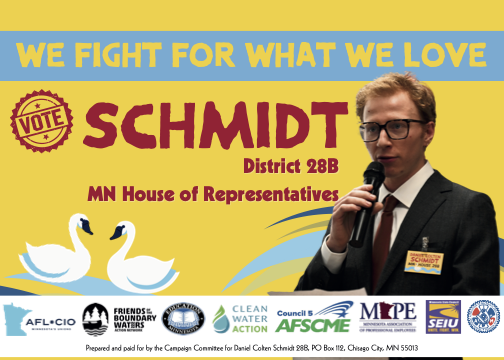
I am now endorsed by two environmental organizations and six labor unions. I am so proud to represent the values of these extraordinary organizations.